
- About Us
-
Services
- Our Clients
- Memories
- Pay Now
- Contact Us
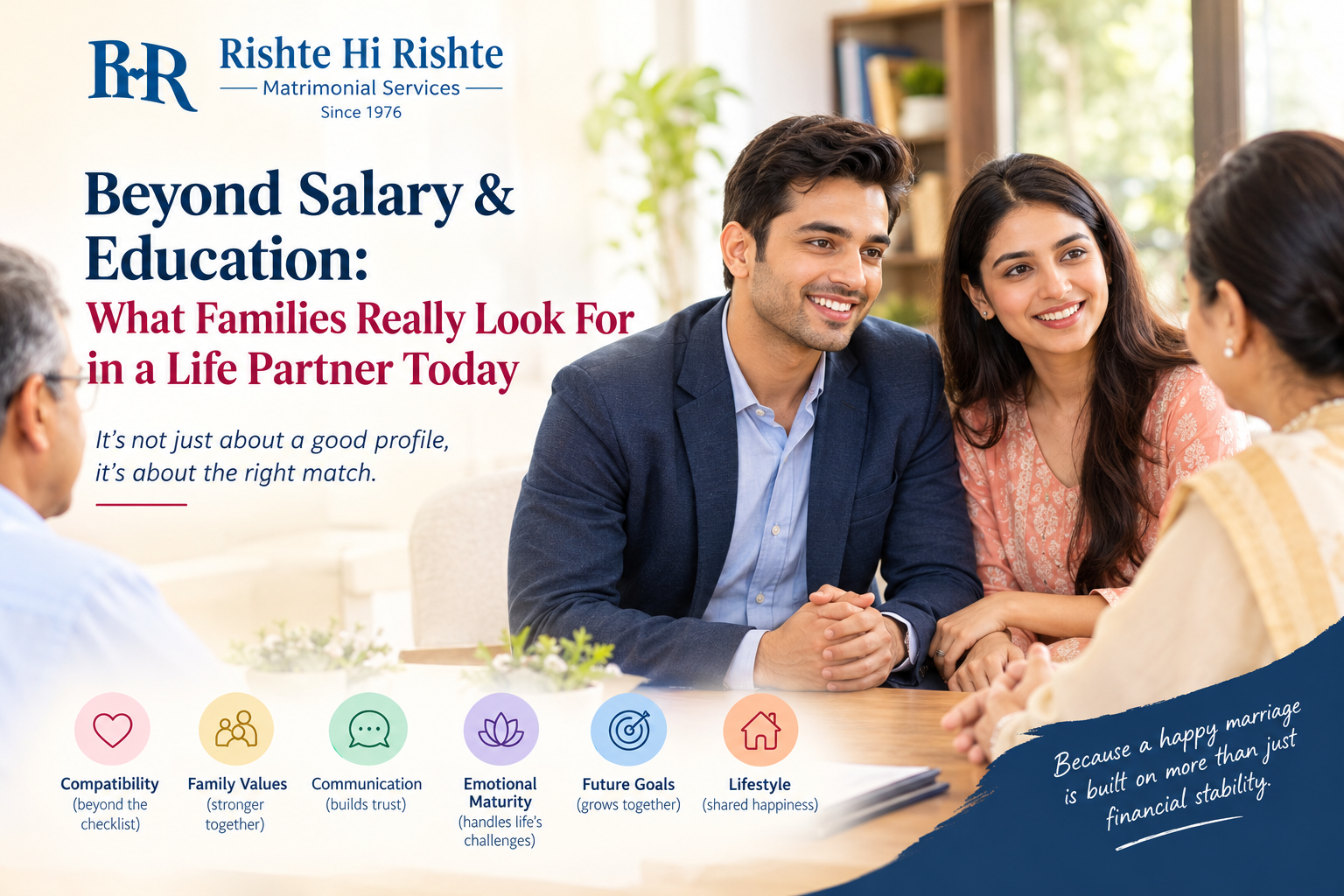
For generations, salary, education, profession, and family background have been important factors when families searched for a suitable marriage alliance. But today, the way people approach marriage is changing. While financial stability and education continue to matter, many families are looking beyond a biodata or professional profile to understand whether two people can genuinely build a happy life together.
Modern families increasingly want to know more about a prospective life partner’s personality, values, lifestyle, communication, emotional maturity, family expectations, and long-term goals.
In other words, finding a suitable life partner today is becoming less about simply checking boxes and more about finding meaningful compatibility.
A good educational qualification or successful career can tell you about a person's professional journey, but it cannot tell you everything about how two people will live together.
Families today often consider questions such as:
Compatibility does not mean two people need to be exactly alike. Differences can exist in a healthy relationship when both individuals understand, respect, and support each other.
Modern matchmaking does not necessarily mean moving away from family values.
For many Indian families, understanding a prospective partner's values and attitude toward family remains important. However, families are increasingly looking at values in a broader way.
They may want to understand:
A strong marriage often requires understanding not just two individuals, but also the expectations and environment surrounding them.
Marriage involves making decisions together, discussing differences, managing responsibilities, and supporting one another through different stages of life.
That makes communication an important part of compatibility.
Families may therefore look beyond a person's qualifications and ask whether the prospective partner can:
Good communication can help couples understand each other better before and after marriage.
Emotional maturity is not about being perfect or never having disagreements. It is about how a person responds to situations, responsibilities, differences, and challenges.
A mature prospective partner generally understands that marriage requires:
These qualities may not appear on a traditional matrimonial biodata, which is why meaningful conversations and interactions are important before making a marriage decision.
Two people may have similar education and professional backgrounds but completely different lifestyles.
For example, one person may enjoy travelling frequently while another may prefer a quiet home life. One may be highly social, while the other may prefer a smaller circle.
Lifestyle differences are not automatically a problem. What matters is whether both individuals understand these differences and can find a comfortable way to live together.
Families may therefore discuss areas such as:
Professional success remains an important consideration, but families are increasingly interested in understanding future goals, not just current salary.
For working professionals, useful conversations can include:
These discussions can help identify whether two people have compatible expectations about the future.
A high income does not automatically mean financial compatibility.
Families may also consider how responsibly a person manages money.
Important conversations can include:
The objective is not to judge someone purely by their income, but to understand whether both individuals have realistic expectations about their future together.
Marriage does not mean that two people have to give up their individual identities.
Modern couples may have their own careers, friendships, interests, ambitions, and personal goals. Families therefore increasingly value a partner who respects individuality while also understanding the importance of the relationship.
A healthy relationship can allow both partners to grow personally and professionally while building a life together.
One of the most important parts of modern matchmaking is understanding what both individuals actually expect from marriage.
Before saying yes, couples can discuss:
These conversations can prevent misunderstandings later.
A matrimonial profile can provide useful information, but it is only the beginning of the matchmaking process.
A person's real nature becomes clearer through conversations, interactions, and the way they treat other people.
Families may therefore pay attention to qualities such as:
Honesty + Respect + Responsibility + Kindness + Communication + Understanding
These qualities can become just as important as education, profession, or income when considering long-term compatibility.
The definition of a suitable match is evolving.
Earlier, families might have primarily compared education, profession, salary, family background, and location. Today, many families consider these factors alongside personality, values, lifestyle, communication, expectations, and compatibility.
This does not mean traditional criteria have become irrelevant. Instead, the matchmaking process is becoming more comprehensive.
The goal is not simply to find someone who looks good on paper.
The goal is to find someone with whom an individual can potentially build a respectful, supportive, and fulfilling life.
Finding suitable matches can become challenging when families have limited networks or very specific preferences.
A professional matrimonial service can help bring together profiles based on factors such as age, education, profession, location, family background, lifestyle preferences, and other requirements.
However, matchmaking should not stop at matching profile details. Families and individuals should take sufficient time to communicate, understand each other, ask important questions, and make their own informed decision.
At Rishte Hi Rishte, our approach to matchmaking focuses on understanding individual and family requirements and connecting them with suitable matrimonial profiles. With experience in matrimonial services, our aim is to make the search for a life partner more organized, personalized, and family-oriented.
A successful marriage is built on much more than a salary package or educational qualification.
Education and financial stability are valuable considerations, but qualities such as compatibility, communication, respect, emotional maturity, family values, lifestyle, and shared expectations can play an important role in building a lasting relationship.
As matchmaking evolves, families are increasingly looking beyond the biodata to understand the person behind the profile.
After all, a life partner is not simply someone who matches your checklist — it is someone with whom you can potentially build your future.
Looking for a suitable life partner? Explore personalized matrimonial matchmaking with Rishte Hi Rishte and take the next step toward finding a meaningful match.

